Author Interview: Alison Kervin
Alison Kervin is the author of the hilariously funny A WAG’s Diary and A WAG Abroad - both of which I loved and her third novel, Celebrity Bride (which I’ve just read and reviewed - look out for it soon!), was released in June. She kindly agreed to do an interview with us and here are her answers!
1. Describe your latest novel in a sentence.
Celebrity Bride is about a beautiful young girl who falls head over heels with a handsome, rich man who also happens to be the most famous actor in the world. Meeting him pulls her into a new and complex world which has her becoming paranoid and worried about her life, her friends and her love. She even finds herself caught up in a murder investigation. It’s light and humorous but with a darker edge that looks at the world of celebrity, female friendships gone wrong, and what it is out of life that we all really want… (sorry, not a sentence!!)
2. What, if anything, are you currently working on?
I’m working on the follow up to Celebrity Bride which doesn’t have a title yet, but will follow Kelly, the heroine of CB, on the next installment of her life…
3. Where do you get your book ideas?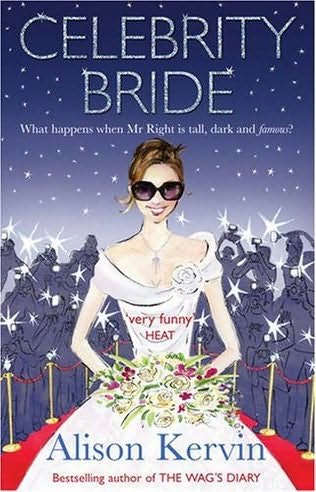
I don’t know…it’s a good question, but one that’s impossible to answer. I guess a lot of them come from asking ‘what if…’ So Celebrity Bride began with me watching Brad Pitt and thinking…what if someone really normal and down to earth was going out with him? How would she cope? Is it any coincidence that most of the huge, high profile stars end up with other high profile stars? Is it because they’re the people they meet, or is there something about the lifestyle that makes it impossible for a ‘real’ person to infiltrate? Then I started thinking about the barriers that would exist…what if the press intrusion became too much? What if a girlfriend found she had more in common with the staff than with the star’s friends? What if one of those friends turned against her? Then, before you know where you are, you’ve got a book!
4. Will we hear from Tracie again? She was a great character!
Thank you. I’m thrilled with how popular she became (she was even sent Christmas cards and Christmas presents!). The aim of the Wags books was to create a character who was an out and out Wag (with all that’s good AND bad about that) but still make her likeable. I, personally, really took to Tracie during the writing of the book, and found I could throw her into all sorts of obscure scenarios and have her emerging intact because she was such a sweet and fundamentally decent person. Creating characters is my favourite part of writing novels so I’m really pleased she turned out to be so popular (even while behaving like a nutcase!). To answer your quesiton…I am hopeful that we can bring Tracie back for a final book, but there are no concrete plans yet!!
5. How did you get published, how long did it take?
I worked as a journalist before I became a novelist, and wrote non-fiction before I tried fiction. Getting published as a non-fiction writer wasn’t too hard because I had very good contacts from my time as a journalist, so I start writing autobiographies and writing books about sport. The move to fiction was more difficult, but once I had the idea for a Wag who was every inch a Wag, and got herself into all sorts of trouble, but was very likeable, I was well on the way.
6. What are you currently reading/who are some of your favourite authors?
I read all sorts of books - a mixture of modern literature and classics. I think it’s a mistake to restrict yourself to one genre…you can find as much that’s real and vibrant in George Orwell’s work as you can in Marian Keyes. It’s also a mistake to think of modern women’s literature (chick lit) as being entirely devoid of literary merit. Some of the women writing today are supremely talented story tellers, as adept with language as any from previous generations. I sometimes think we make the mistake of not crediting an author with talent until they’re dead. There’s no question that Jane Austen was talented, and it would be a huge mistake not to read her work, but don’t dismiss modern writers out of hand.
In terms of my own personal favourites, I love Graham Greene, especially ‘The End Of The Affair’. I think his use of language is beautiful. What else? Ummm…
I think the structure of Wuthering Heights is astonishingly clever, since the narrator, and the man through whom we hear everything, is not actually involved in the story. Catch-22 is a masterpiece on so many levels (well worth a read - it’s funny, silly and clever all at once). I also like Marian Keyes, Zadie Smith, Nick Hornby, JM Coetze and Margaret Attwood and soooo many others (and the minute I send this quesitonnaire off, I’m gooing to think of loads of people I should have mentioned!!)
7. Are any of your characters like you in anyway?
No, no, not at all. Not in any way. Well, perhaps a little bit. I think you inevitably dredge yourself and your friends for characteristics for characters. No one character is like me, but one character may have the same attitude to food as me, another may have the same approach to relationships as me, another may have the same approach to work…so you do definitely inform your characters and bring them to life through your own experiences, but none is actually ‘like’ me!
8. What advice would you give to aspiring writers?
I’m often asked this question and, to be honest, it’s very hard to give sensible advice because writing’s such a personal thing. My little boy, George, comes home from school and says ‘mummy, what did the people in your head do today?’ and if you think about it – writing is an obscure way to make a living…transferring the images, thoughts, characters and situations that exist entirely in your mind, onto paper, in the hope that people will want to read about them! Since everyone’s mind is different, I guess there are always going to be different ways of doing that.
But, for what it’s worth, I think you’ve just got to sit down and do it…try and write something every day. If you write just one page a day you’ll have a book written this time next year. Make sure you read a lot too; it’s vitally important to read everything you can get your hands on. Every time you read and write you learn, so do it whenever you can.
When it comes to the actual writing, I think the key to making fiction work is to have strong, compelling characters; they drive everything. If your characters are right, you can take the book anywhere, without good characters you’re very limited. I spend most of my time before writing novels working out exactly what sort of people my characters will be. I have big sheets of paper on the wall at home with outlines of what the characters look like, where they work, what their parents do for a living, when they were born, and I’ve got pictures cut from magazines illustrating what they look like, and floor-plan sketches of their homes. As I said, all writers work differently, but for me it begins and ends with characterisation above all else.
Finally, the piece of advice frequently given to novelists is “show, don’t tell”. This is vitally important and distinguishes good fiction from bad fiction in so many ways. It applies to non-fiction too, and to journalism. If there’s a way of getting your point across using an illustration rather than a statement, always do it. It’s the little vignettes that stay in people’s minds when they put a book/newspaper down. Don’t say ‘he’s brave’ – show him being brave. Don’t say ‘he was tall’ show him ducking under a door to illustrate how tall he is. It always works much better. Good luck
Tags: Alison Kervin
- Digg
- Stumble it!
- Author Interview: Alexandra Potter
- AW Author Interview: Elodia Strain
- Author Interview: Lucy-Anne Holmes